AI in Modern Advertising: TV and Digital Production with Purpose
Artificial intelligence is already part of modern advertising. It is used in script development, visual concepts, editing, image processing, content generation, media planning, personalization of digital campaigns, and consumer behavior analysis. For TV and digital advertising, AI has opened real opportunities: faster preparation, more content variations, more flexible adaptations for different channels, and more precise testing of ideas.
But precisely because AI is so accessible and impressive, it often creates the wrong impression that every advertising task should be solved through artificial intelligence. In practice, this is not the case. In many situations, standard professional methods — a strong brief, a clear creative concept, an experienced director, a skilled cinematographer, real actors, careful editing, authentic sound, and well-managed production — remain not only sufficient, but better, more effective, and more reliable.
At Domino Production, we approach AI as a tool, not as a replacement for professional advertising production. It makes sense when it improves the result, saves real time, expands creative possibilities, or helps the team achieve a higher-quality advertisement. But AI should not be used simply because it is trendy.
AI Is Not the Idea. AI Is the Tool
One of the most common mistakes in using AI in advertising is replacing creative thinking with a technological effect. Advertising does not start with the tool. It starts with the problem: what do we want to say, who are we saying it to, why should that person believe us, and what action do we expect from them?
If these questions are not answered, AI can produce more content, but not necessarily better content. This is especially important in advertising videos, TV commercials, brand films, and digital campaigns, where the message, emotion, and trust matter more than the visual effect itself.
In TV advertising, a well-captured human moment, a natural reaction, a genuine emotion, or a precisely directed situation often has a much stronger impact than a visually impressive but empty AI-generated scene. Viewers can sense when an ad is made with an understanding of people — and when it is simply a demonstration of technology.
In digital advertising, AI can be extremely useful for creating different formats, adaptations, headlines, A/B testing variations, dynamic banners, and personalized messages. But the same rule applies: if the strategy is weak, AI will only scale the weakness. A poorly positioned brand, an unclear message, or a misunderstood audience will not be saved by automatically generated visuals and copy.
When AI Makes Sense in Advertising Production
AI is most useful when it solves a specific problem, not when it is used merely for effect. It can improve advertising production when it speeds up technical processes, expands visual possibilities, supports pre-visualization, optimizes versions for different channels, or allows more creative directions to be tested with less risk.
In the preparation of a TV commercial, AI can help create moodboards, storyboard references, concept frames, or rough animatics. This improves communication between client, agency, director, and production team. When everyone can see the direction more clearly before the shoot, the process becomes more precise and more efficient.
In post-production, AI can support rotoscoping, upscaling, audio clean-up, generation of additional background elements, color references, or acceleration of certain VFX processes. In these cases, technology does not replace professionals. It gives them more control, more time for creative decisions, and more opportunities to polish the final product.
In digital environments, AI is particularly practical for creating adaptations for social media, performance campaigns, short-form videos, banners, different copy variations, and personalized messages. It can help brands communicate more flexibly, as long as there is a clear strategy and a solid understanding of the audience behind it.
When AI Is Not the Best Choice
There are situations in which using AI can harm an advertisement. This happens when the technology is used without a clear reason, when the result feels inauthentic, when the brand needs trust and human presence, or when the production team does not have enough experience to control the quality of the AI output.
AI can generate beautiful images, but it does not always understand context. It can suggest copy, but it does not always capture the exact tone of the brand. It can create video, but it often struggles with details, movement, consistency, physics, faces, hands, product accuracy, and legal safety. In advertising, these are not minor issues.
A wrong detail on a product, an inaccurate visualization of packaging, unnatural human behavior, or an unconvincing scene can compromise the entire campaign. In TV advertising, where production quality is perceived instantly, excessive or poorly executed use of AI can look cheap, no matter how modern the technology is.
Sometimes a real set, strong casting, confident direction, and a professional film crew are faster, more controllable, and more impactful than trying to generate everything. This is especially true when the advertisement needs to communicate trust, human warmth, a premium feeling, or concrete product credibility.
Efficiency Is Not Only About Speed
One of the main arguments in favor of AI is speed. Artificial intelligence can indeed save time. But in advertising, speed is not the only criterion. Accuracy, emotion, trust, brand consistency, and the real effect on the audience are just as important.
A faster-produced advertisement is not automatically a better advertisement. If AI saves time at the beginning but later leads to long revisions, legal concerns, visual inconsistencies, or confusion in the message, the efficiency disappears. Sometimes the traditional process — with a clear script, a professional team, and well-managed production — is more predictable and more economically reasonable.
This also applies to digital advertising. Mass-generated content may create a sense of activity, but not necessarily a sense of value. Brands do not simply need to publish more. They need to say the right things, to the right people, at the right moment, in the right format.
The Best Approach Is Hybrid
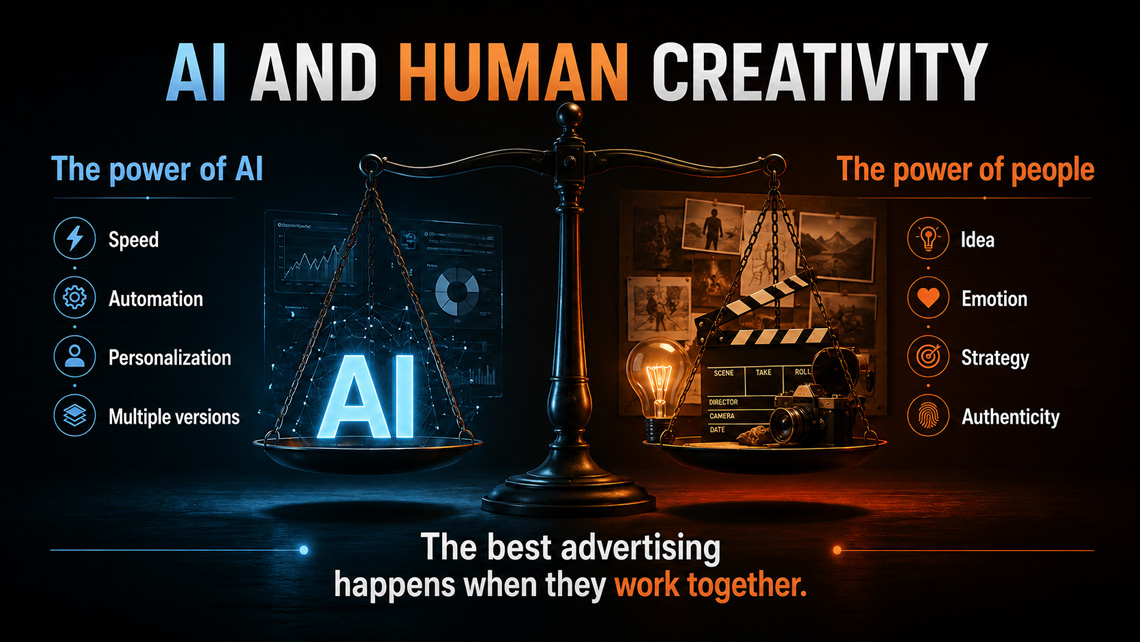
A mature approach to AI in advertising is neither blind admiration nor complete rejection. The best results come from hybrid work: human strategy, human creativity, and professional judgment, supported by AI wherever it genuinely adds value.
AI should be part of the toolkit, but not the center of the thinking. The decision to use it should come after specific questions:
- What exactly will AI improve in this production?
- Will it make the advertisement better, clearer, or more impactful?
- Will it truly save time or budget?
- Will it create an opportunity that would otherwise be impossible or unreasonably expensive?
- Can we control the result?
- Do we understand the creative, technical, and legal risks?
When the answers are clear, AI can be a powerful ally. When they are not, it can easily become expensive noise.
Domino Production’s Approach
For Domino Production, quality advertising does not start with the question “Which technology should we use?” It starts with the question “What result do we need to achieve?” Sometimes the best solution is an AI-assisted process — for example, for visual references, fast concepts, digital adaptations, or post-production improvements. Other times, the best solution is classic production with real people, a real environment, strong direction, and control over every detail.
What matters is that the choice is professional, not fashionable. AI can be a valuable tool in TV and digital advertising, but only when used with a clear purpose and by a team that understands both technology and advertising communication.
Conclusion
Artificial intelligence is changing advertising, but it does not cancel its core principles. Good advertising still depends on a strong idea, precise strategy, understanding of the audience, quality production, and professional instinct. AI can speed up, expand, and enrich this process, but it cannot replace the need for thinking.
That is why the most reasonable question is not “Can we use AI?” but “Should we use AI here?” If the answer is yes — and if the team knows what it is doing — technology can improve production quality and open new creative possibilities. If the answer is no, standard methods are not outdated. On the contrary, they are often the most direct path to clear, human, and effective advertising.
Ultimately, AI does not make advertising better by itself. Advertising becomes better because of the people who know when to use AI — and when not to.